
The Colorado Provençal is one of the most fascinating places in Provence! It is located in Rustrel, in the Vaucluse department, about ten kilometers from Apt.
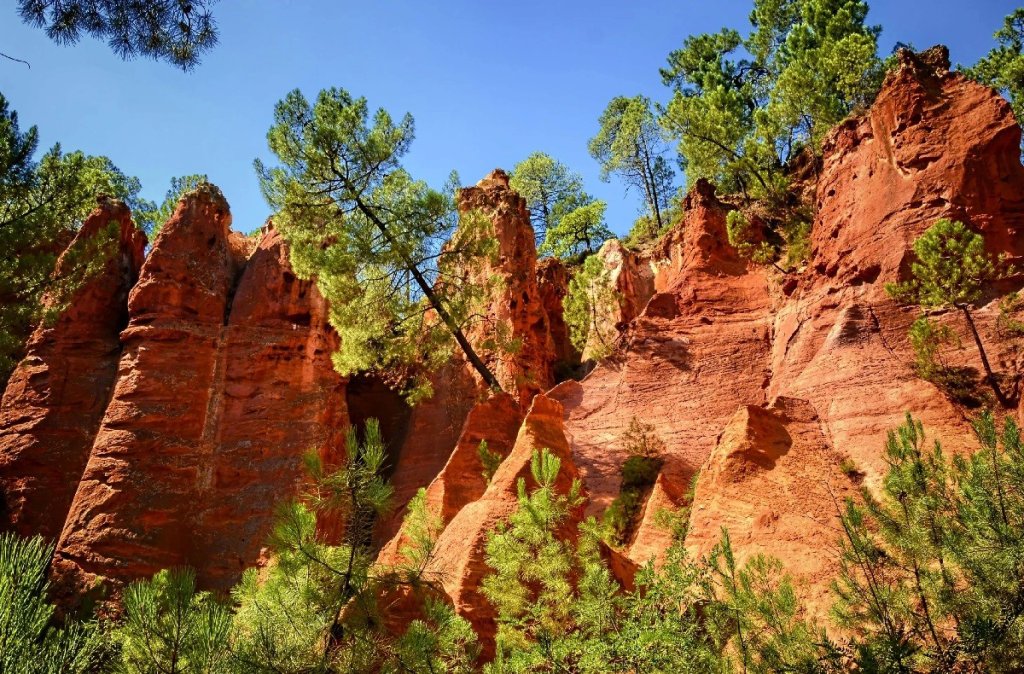
This former ochre mining site has been transformed into a protected natural area resembling a canyon. The site can only be explored on foot, via marked trails starting from the Mille Couleurs parking lot. There are two different trails: the Sahara Trail, approximately 2 km and 40 minutes long, and the Viewpoint Trail, approximately 3.9 km and 1 hour 45 minutes long. Admission to the site is included in the parking fee, which ranges from about 6 to 9 € per car depending on the season. The site is open from February through mid-November, with online reservations required in the morning during peak season.
That covers the basics. But the “Provençal Colorado” deserves more than just a checkmark on your Provence itinerary.
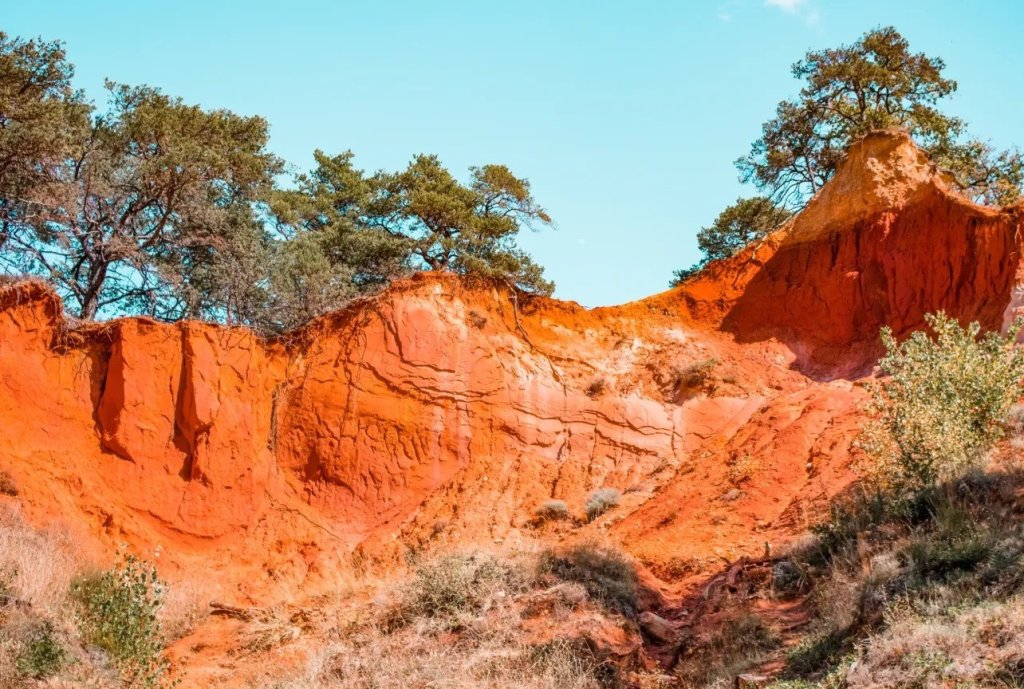
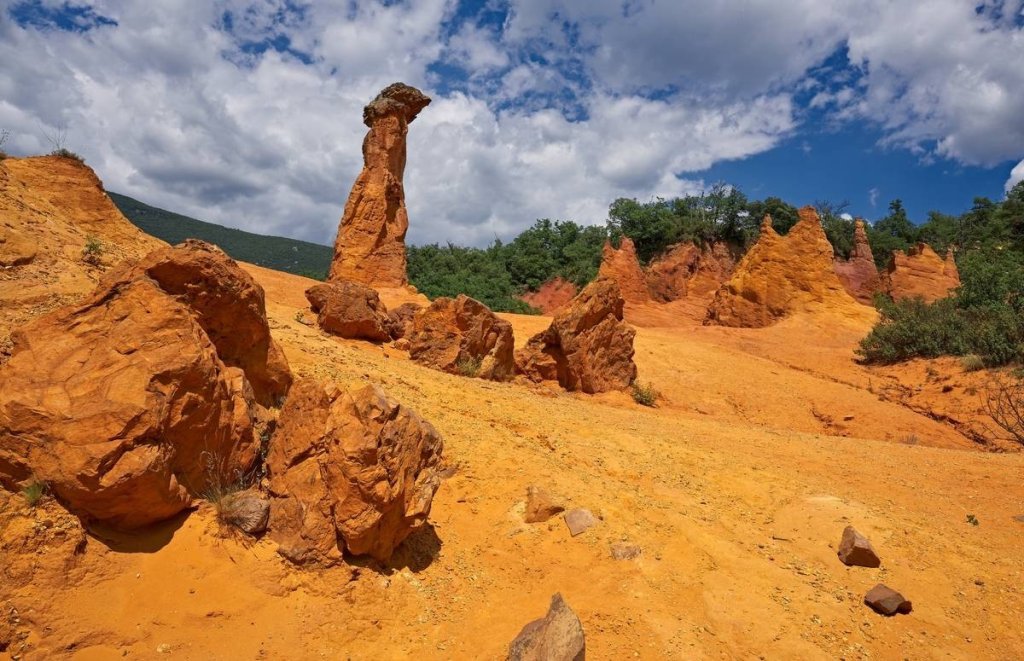
The cliffs shift from pale yellow to blood red depending on the time of day and the light. Fairy chimneys suddenly appear around a bend in the trail. The sand crunches under your shoes, and you quickly understand why the locals speak of a thousand colors. This landscape isn’t just natural—it bears the marks of the ochre miners who dug into the earth here starting in the late 19th century.
Discover all the secrets of the Colorado Provençal: when to visit, which trail to choose, how to avoid the crowds, and where to park without risking a fine.
How to visit the Colorado Provençal?
Visiting the Colorado Provençal is very simple. It all starts at the Mille Couleurs parking lot, on the RD22 in Rustrel. This is the site’s only visitor center. There you’ll find the ticket office, a trail map, and staff from the association.
The site can only be explored on foot. No vehicles are allowed on the trails—no cars, bikes, or motorcycles. Leave everything at the parking lot and set off on the marked trails.
Online reservations are required for morning visits from May through August. This applies to cars, minibuses, and RVs. After 1:00 p.m., you can enter without a reservation by going directly to the ticket office. In July and August, opening hours are posted the day before around 6:00 p.m., and reservations open at that time.
Hours vary by month. Hours are 8 a.m.–7 p.m. in July and August, 9 a.m.–6 p.m. in September, and 9:30 a.m.–5:30 p.m. in October. Last admission is at closing time, with mandatory exit one hour later.
For any last-minute information, the site’s automated voice service is available at 04 90 75 04 87. The association’s mobile number is 06 43 97 76 06. The administrative office is available to handle your inquiries Monday through Friday, from 9:00 AM to 5:00 PM. One final tip: the ticket price includes an activation code for the mobile discovery app—be sure to ask for it.
Once you’re there, all that’s left is to choose how you want to spend your day.
Activities at Colorado Provençal
There are two marked trails to explore Colorado—and nothing else. The first is called the Sahara Trail, marked in blue. It’s 2.1 km long and takes about 40 minutes round-trip from the parking lot. The elevation gain is only 10 meters, making it easy for almost everyone.
The second is the Belvédères Trail, marked in orange. It’s 3.9 km long, takes 1 hour and 45 minutes to walk, and has an elevation gain of 70 meters. It encompasses the Sahara Trail and overlooks it. From the viewpoints, you’ll have a commanding view of the dunes, the white desert, and the fairy chimneys.
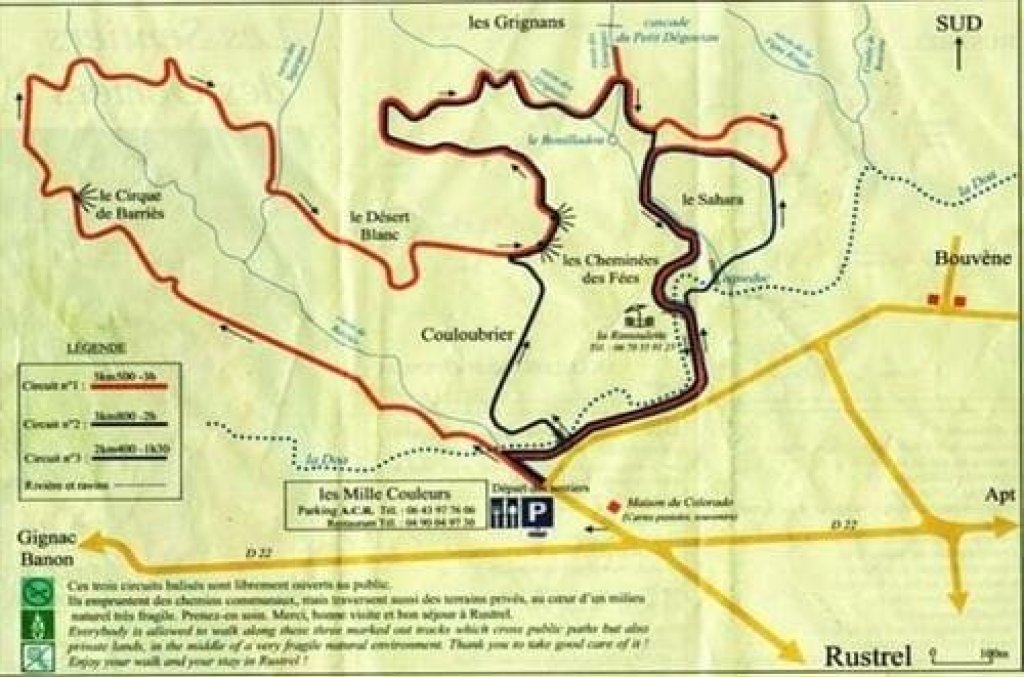
This hike is family-friendly. Young children can manage it easily, but strollers cannot: the paths are sandy, with narrow sections. A baby carrier may be available at the ticket office, depending on availability. Dogs are allowed throughout the site, provided they are kept on a leash.
Photography is, of course, the main attraction here. The low-angle light in the morning and late afternoon brings out the best colors. A scavenger hunt is also available to keep children entertained along the way. And if you’d like to continue exploring the Luberon’s ochre deposits, the Ochre Trail in Roussillon and the Bruoux Mines in Gargas are great additions to the tour, both less than twenty minutes away by car.
A guided tour is also available, except in July and August. It lasts 1 hour and 30 minutes along the Sahara Trail and recounts the history of ochre mining. Indeed, this history is well worth exploring.
The History of the Provençal Colorado
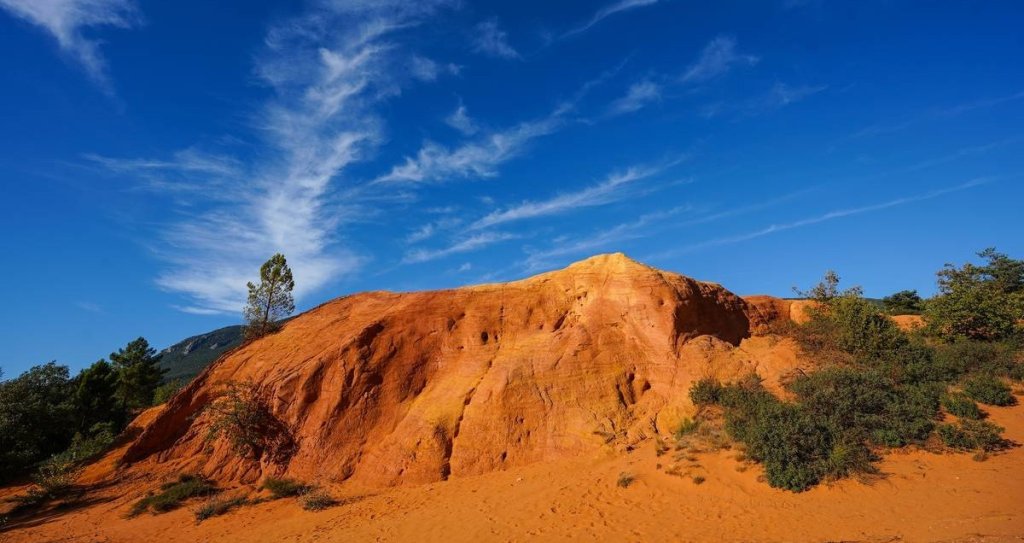
The Provençal Colorado is a former open-pit ochre mining site. The first pickaxe struck in 1871. The farmers of Rustrel then turned to ochre mining during the off-season in the fields. The decline of the iron industry in the town accelerated this shift.
Several factors fueled the growth of this industry. Ochre had always been used as a pigment, but 19th-century industry found another use for it: it served as a thickener for natural rubber. The arrival of the steam train in Apt in 1877 made it possible to ship the goods to the port of Marseille. From there, Rustrel ochre was shipped all over the world.
Mining proceeded at a steady pace. In 1885, twelve mining sites were operating in Rustrel. By 1925, there were twenty-two, employing about a hundred workers. The 1929 economic crisis, followed by the advent of synthetic pigments, brought this industry to an end.
The final pickaxe blow was struck in 1991 by Roger Arnaud, the last active ochre miner. The last ochre wash took place two years later.
The site is now classified as a natural monument of historical significance. You can still see the remnants of this industrial heritage there: quarry faces, settling ponds, channels, and pipes. Geology does the rest, with these ochre-colored sands of marine origin that erosion continues to sculpt. The landscape you’re photographing is therefore as much a product of human activity as it is of nature.
When is the best time to visit?
The site is not open year-round. It closes annually in mid-November and reopens in early February. This leaves you with a visiting season of about nine months. The high season runs from May through September, while the low season covers February–April and October–November.
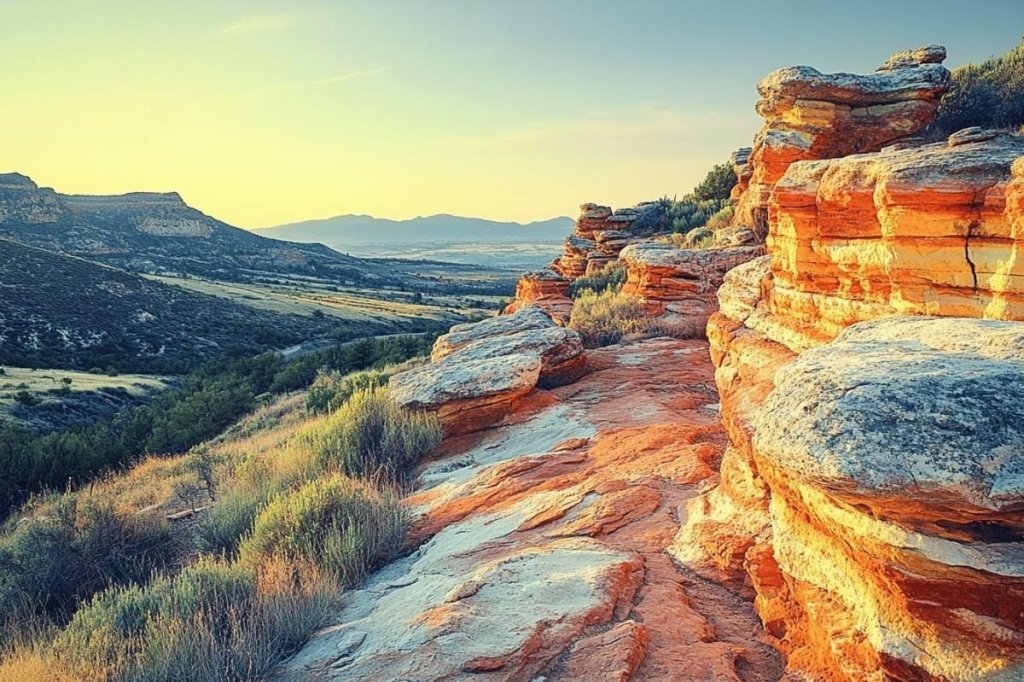
Spring is probably the best time to visit. Temperatures remain mild, the vegetation comes back to life, and visitor numbers stay reasonable. Be careful of processionary caterpillars during this season, especially if you’re traveling with a dog.
Fall is also a great time to visit. In October, the weather remains pleasant, and the low light flatters the ochre hues. Low-season rates apply, and reservations are no longer required. This is probably the best balance between comfort and tranquility.
Summer requires more preparation. In July and August, the site opens at 8 a.m., and that’s when you need to arrive. The heat builds up quickly on the sun-drenched trails, set against a backdrop of sand. Online reservations are required for the morning, and they fill up fast.
One final factor to consider when choosing your visit date: the risk of wildfires can affect access conditions in the summer. We’ll come back to that below. Before that, let’s talk about the cost.
Prices
The admission fee for Colorado Provençal is calculated per vehicle, regardless of the number of passengers. That’s the basic rule, and it makes all the difference if you’re coming with family or friends. The price includes parking, access to the trails for all vehicle occupants, a map of the trails, and the activation code for the mobile discovery app. Parking is subject to a fee, and this payment grants you access to the site.
For a car, expect to pay between €6 and €9 depending on the season. A motorcycle costs between €4 and €6, and a RV between €10 and €12. A minibus costs between €13 and €15. Cyclists and pedestrians pay between €2 and €3.
The lowest rate applies during the off-season, from February through April and from October through November. The higher rate applies from May through September. In other words, a car that costs €6 in March will cost €9 in August. For a family of four, admission therefore comes to just over €2 per person in the height of summer.
Buses and tour buses are subject to a different system, with a per-passenger rate and mandatory reservations. Organized groups must consist of at least fifteen adults. The guided tour costs €9 per adult and €4 for each child aged 6 to 12, with free admission for children under 6. Residents of Rustrel have free access to the site upon presentation of the Rustrel PASS.
Payment can be made in cash, by credit card, or by check. Vacation vouchers are not accepted. For online reservations, only the standard rate applies. So plan on a very reasonable budget for this exceptional site: the price of a cup of coffee per person—or almost.
What are the risks during the visit?
The fire risk is the first thing to check before setting out. From June 15 to September 15, access to the Vaucluse forest areas is regulated by prefectural decree. At “red” alert level, only the Sahara trail remains open under a special exemption. At “extreme red” alert level, the Colorado closes entirely.
You can find this information on the Colorado’s official website, via its voice response system, or on the Vaucluse Prefecture’s website. The Colorado trail is located in the Apt Valley mountain range. Smoking and lighting fires are prohibited on the site year-round.
The second hazard comes from the cliffs. These are former quarry faces, and they are eroding. Falls and rockfalls are possible. Access to the “fairy chimneys” area and other cliffs is prohibited by municipal ordinance.
A few simple safety precautions can prevent most accidents. Wear appropriate footwear, especially on the Belvédères trail, where tree roots and stream crossings require caution. Bring water, a hat, and sunscreen. In the event of high water, never cross the Doa River; call emergency services instead.
The association may close the site at any time for your safety. These temporary closures last an average of two hours. In this case, reschedule your visit rather than parking on the side of the road. Which brings us to the final point: access.
How do you get to the Colorado Provençal?
The Colorado Provençal is located along the RD22, the road connecting Apt to Banon, near the village of Rustrel. The address to remember is simple: Mille Couleurs parking lot, RD22, 84400 Rustrel. The GPS coordinates are 43.919917 N and 5.499271 E. Parking is available exclusively in this lot.
An important warning about the route: don’t blindly trust Waze or Google Maps for the final few kilometers. These apps regularly provide incorrect directions in this area. Road signs, on the other hand, provide very clear directions to the site. Follow them from Apt or Saint-Saturnin-lès-Apt.
From Apt, it’s about 10 kilometers via the RD22, passing near Caseneuve. From Aix-en-Provence, plan on about 1 hour and 15 minutes by car. From Marseille, allow about 1 hour and 45 minutes. A visit to Le Colorado can easily be combined with a day trip to the villages of the Luberon.
Parking outside the designated parking lot should be avoided at all costs. The police regularly issue tickets to vehicles left on the shoulders of the road. Spaces reserved for emergency vehicles are towed. And vehicles parked in fields or on private property are sometimes vandalized.
If you’re coming by bike, you can park your bike near the ticket office for the pedestrian rate. Bike locks are available on a first-come, first-served basis, but the site does not have a bike lock-up or charging stations. Finally, please note that the trails are not accessible to people with reduced mobility who use wheelchairs.